
Ask any experienced deck builder and they’ll tell you: wood fights you. Boards and joists arrive with different moisture content, they swell and shrink unevenly, and over time a wood surface can go wavy. To compensate, builders taper and grade their joists from highest to lowest and design around the material’s unpredictability. Those workarounds don’t just cost time — they quietly limit what’s possible.
WearDeck removes that limitation. Because every piece is manufactured to be dimensionally identical, our designs aren’t constrained by the compromises wood demands. There’s no tapering, no grading, no compensating for warping and swelling. What we draw is what we build, board for board.
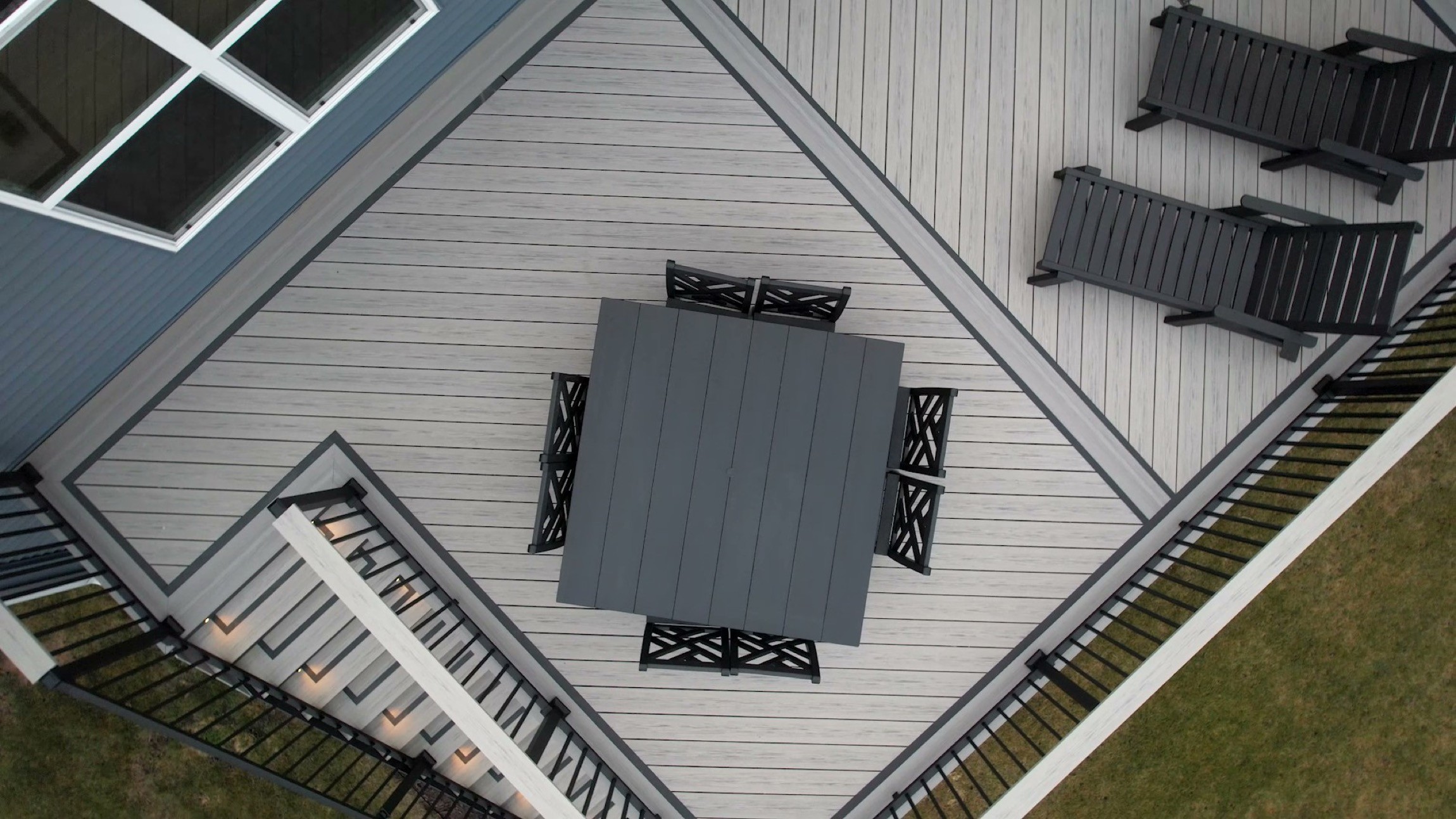
That consistency is exactly what makes our sculptural work possible. When you look at a deck surface where 9.5-inch boards have been ripped into 3.5-inch strips and laid like pavers, framed by picture-frame borders up to 10 inches wide in mixed widths and colors, you’re looking at precision that a warping, moving material simply couldn’t hold over time.
This is the point most people miss about premium materials. It isn’t just that WearDeck lasts longer — it’s that it unlocks forms, spans, and details that would have sagged or failed with wood. Designs that were previously impossible are now achievable for the first time.
So when we say the deck becomes an expression of design rather than just a structure, this is the engineering behind that claim. Consistency isn’t a boring virtue here. It’s the freedom that lets the artistry happen.